

What is Form 8849?
If your business pays federal excise tax as part of everyday operations (fuel purchases, certain sales, communications, transportation, and other niche categories), there is a good chance you have asked a very practical question at least once: “Can we get any of this back?” IRS Form 8849 is one of the main ways businesses claim refunds or credits for excise taxes they paid but ultimately did not owe.
This guide explains what is Form 8849, who typically qualifies, and how the filing process works, with practical comparisons to other options like Form 720 and Form 720-X.
What is Form 8849?
Form 8849 (Claim for Refund of Excise Taxes) is an IRS form used to request a refund (or in some cases a credit) for certain federal excise taxes. Most commonly, it is used when excise tax was paid on a transaction, but later facts make that tax refundable, for example, fuel used for an off-highway business purpose or fuel used by a governmental entity.
While Form 720 is the quarterly return used to report and pay many federal excise taxes, Form 8849 is generally used to claim back eligible excise taxes already paid.
For official instructions and the current revision, use the IRS pages for Form 8849 and the associated instructions.
Form 8849 vs Form 720 vs Form 720-X (which one should you use?)
This is where many filers waste time. The right form depends on whether you are (1) reporting tax due, (2) correcting a previously filed return, or (3) claiming a refund for excise tax paid.
| Need | Usually the right form | What it’s for | Typical scenario |
|---|---|---|---|
| Report and pay excise tax | Form 720 | Quarterly excise reporting and payment | You owe PCORI fee or other excise taxes for the quarter |
| Correct a filed Form 720 | Form 720-X | Amend a previously filed Form 720 | You reported the wrong IRS number, taxable amount, or liability |
| Claim a refund/credit of certain excise taxes | Form 8849 | Request refund for eligible excise taxes paid | You bought fuel with tax included, then used it in a qualifying nontaxable way |
Where the PCORI Fee fits in
The PCORI Fee is reported on Form 720 (typically filed once per year on the second quarter Form 720 for many plan sponsors). In most situations, PCORI is not a “Form 8849 claim” topic. If a business overpaid PCORI, the fix is commonly through an amended return (Form 720-X) or other IRS guidance for correcting that return, not a fuel-style refund claim.
Who is eligible to file Form 8849?
Eligibility depends on the specific schedule and claim type, but Form 8849 is most often associated with fuel-related credits and refunds.
Common situations where businesses may qualify include:
- Nontaxable use of fuels (for qualified off-highway business use, certain farming uses, some governmental uses, and other defined categories)
- Fuel sold to or used by exempt entities in certain scenarios
- Certain alternative fuel and biodiesel-related claims (when applicable under current law and instructions)
- Other excise tax refund situations listed in the Form 8849 schedules and instructions
The key strategic point is this: eligibility is rarely “industry-based” and almost always “fact-pattern-based.” Two companies in the same industry can have very different outcomes depending on how fuel is used, who the end user is, and what documentation exists.
Form 8849 schedules (what they mean in plain English)
Form 8849 is not a single, one-size-fits-all refund claim. It is a parent form with multiple schedules, and the schedule determines what you are claiming and what proof you need.
Here is a simplified view to help you route the claim correctly (always confirm against the current IRS instructions):
| Schedule theme (simplified) | What it generally covers | Example claim |
|---|---|---|
| Nontaxable fuel use | Refund for taxed fuel used in a qualifying nontaxable way | Landscaping company uses gasoline in off-highway equipment |
| Ultimate vendor claims | Vendor claims refund for fuel sold to qualifying buyers | Fuel seller sells to a governmental entity under qualifying rules |
| Alternative/special fuel claims (when applicable) | Certain claims based on fuel type and use | Alternative fuel use that meets current eligibility requirements |
Filing deadlines and refund timing (what to expect)
Form 8849 deadlines can vary by claim type, but two timing concepts matter for most filers:
- Statute of limitations: Refund claims are generally limited by IRS rules that often depend on when the tax was paid and when the return was filed. (A common framework many taxpayers recognize is the “3-year or 2-year rule” under IRC refund claim rules, but confirm your specific situation with a tax professional and the instructions.)
- Quarterly vs periodic claims: Many fuel-related claims are commonly prepared on a quarterly cadence, even when businesses track the underlying data monthly.
Refund speed depends on claim complexity, completeness, and whether the IRS flags it for review. The best controllable lever is documentation quality.
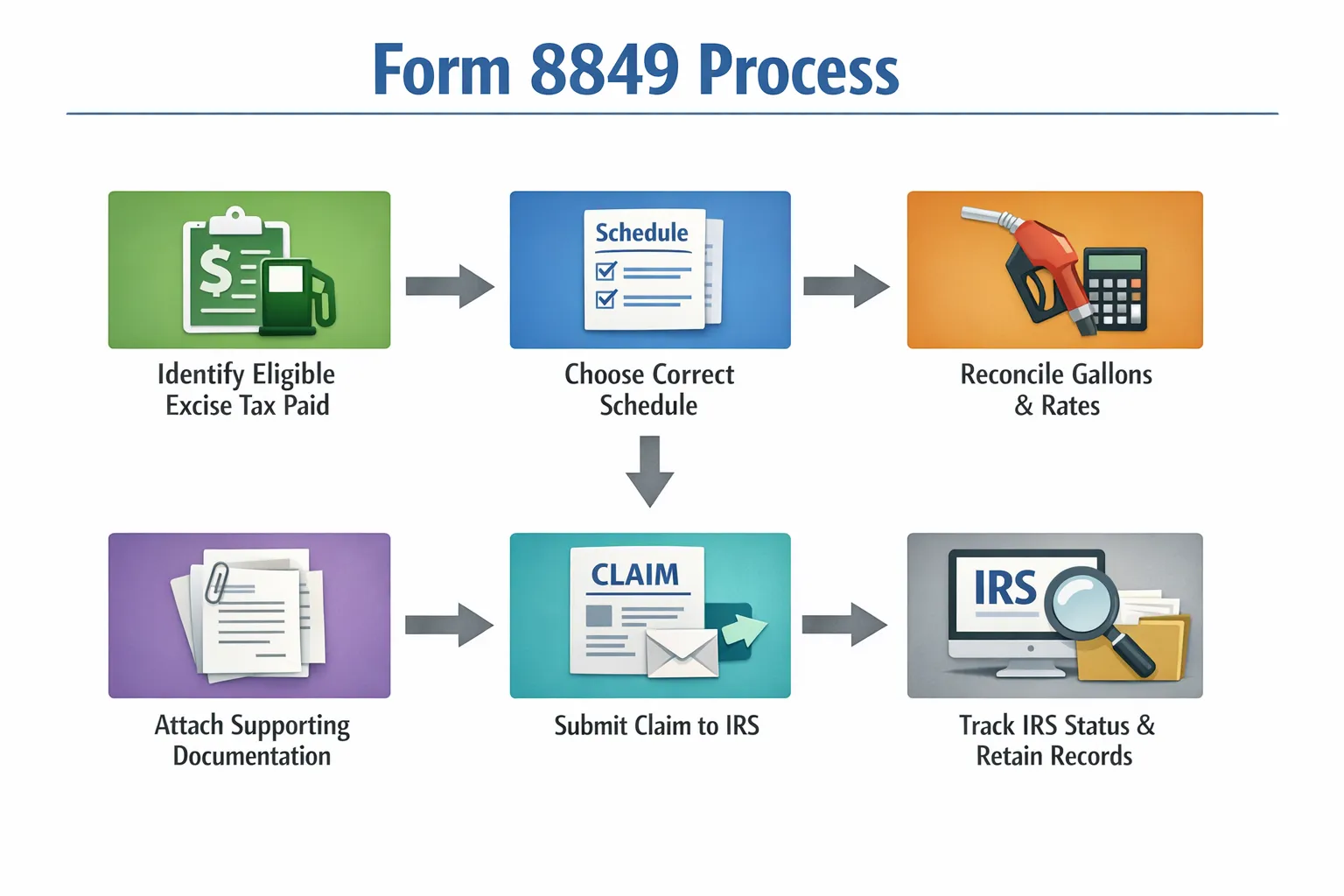
The Form 8849 filing process (step-by-step)
The mechanics are straightforward. The execution is where most delays happen.
1) Identify the excise tax you are trying to recover
Start with invoices, fuel statements, vendor reports, and any internal usage logs. Your goal is to answer:
- What product or transaction had excise tax embedded?
- What was the qualifying use or buyer that makes it refundable?
- Who is the proper claimant (your business, your vendor, or another party)?
2) Map the claim to the correct schedule
Choosing the wrong schedule is a common reason for wasted cycles. Treat this like a routing decision: the schedule determines both eligibility rules and the documentation the IRS expects.
3) Compute the claim amount and reconcile it to source records
Build a simple reconciliation that ties:
- Total gallons (or units)
- Tax rate applied
- Qualifying percentage (if not 100 percent)
- Total refund requested
A clean reconciliation can reduce back-and-forth if the IRS asks questions.
4) Prepare supporting documentation before you file
Many claims fail not because the taxpayer is wrong, but because the taxpayer cannot prove they are right. Keep contemporaneous records such as:
- Usage logs (where, when, and how fuel was used)
- Buyer exemption support (when applicable)
- Vendor invoices and payment evidence
- Any registration numbers or statements required for your claim type
5) Submit the claim using the appropriate method
Depending on your claim type and how you file, Form 8849 may be filed according to IRS instructions for that schedule. Many businesses prefer a structured online workflow to reduce manual errors and create a cleaner audit trail.
Practical lessons learned (and what smart filers do differently)
Businesses that consistently succeed with Form 8849 treat it less like a one-time refund attempt and more like a repeatable compliance workflow.
Lesson 1: Treat refunds like “recoverable costs,” not windfalls
A strong approach is to integrate excise refund tracking into monthly close. If you wait until year-end, you often lose data quality (missing logs, unclear allocations, staff turnover).
Lesson 2: Build a documentation standard, then enforce it
The IRS does not evaluate your claim based on how reasonable it feels. It evaluates based on whether you can substantiate eligibility and calculations.
Lesson 3: Decide early whether Form 8849 or Form 720-X is the cleaner path
If the issue is “we filed Form 720 wrong,” amending may be the right fix. If the issue is “we paid excise tax but qualify for a refund,” Form 8849 may be the right lane.
Filing Form 8849 online with E Eile Excise 720
If you are already managing Form 720 obligations (or you expect to file amendments on Form 720-X), it is often more efficient to handle refunds and claims in the same ecosystem.
With eFileExcise720, businesses can create a free account and use an IRS-authorized e-filing platform designed for excise tax workflows, including support for Form 8849 claims (and related excise filings). If you want help choosing the right filing path, their customer support team can help you understand the process and next steps.
If you have questions about pricing for your specific filing needs or want help with a complex claim scenario, you can contact us through the website.
Frequently Asked Questions
What is Form 8849 used for? Form 8849 is used to claim a refund (or in some cases a credit) for certain federal excise taxes that were paid but are eligible to be recovered under IRS rules.
Is Form 8849 the same as Form 720? No. Form 720 is used to report and pay excise taxes, typically on a quarterly basis. Form 8849 is generally used to claim refunds of eligible excise taxes already paid.
Can I claim the PCORI Fee on Form 8849? Typically, the PCORI Fee is reported on Form 720. If you overpaid PCORI, the solution is often an amended excise return (Form 720-X) or other IRS correction guidance, not a Form 8849 claim.
What documents should I keep for a Form 8849 claim? Keep invoices, proof of payment, usage logs (especially for fuel claims), and any exemption or eligibility support required by the schedule you are filing.
Can Form 8849 be filed electronically? Some excise filings can be handled through IRS-authorized e-file providers. Always follow the current IRS instructions for your schedule and claim type to confirm acceptable submission methods and required attachments.
File Form 8849 with more confidence
Form 8849 is one of the most valuable tools in excise compliance, but only when it is approached strategically: correct schedule selection, tight reconciliations, and audit-ready documentation.
If you want a streamlined way to manage Form 8849 claims alongside Form 720 filings, explore eFileExcise720. Create your account, follow a guided workflow, and reach out to support if you need help deciding the best way to file.